When Your Child Cannot Tell You What Hurts
Recently my husband posted a video of Noah reading an apology to me for hitting me. While this was unusual, we definitely have seen more anger lately. So what do you do?
All parents go through times when their children cannot communicate their feelings. As toddlers this usually comes out in the form of epic temper tantrums, full body flops onto the floor, kicking, screaming, crying and the occasional performance worthy of an Oscar nomination. As children get older, they usually learn to identify when something is bothering them and communicate it. They can tell you their ear hurts, their stomach hurts, they are thirsty, tired, annoyed, hungry, or just mad because someone looked at them wrong.
But what happens when they cannot do this? What happens when they get older and still struggle to identify what exactly is bothering them?
Recently I took Noah for his well visit. He had been a little moodier than usual, but honestly nothing too alarming for a teenager. The doctor looked in his ear and asked, “Has he been complaining that his ear hurts?”
I responded, “No…why?”
Apparently he had a significant amount of fluid in one ear. Basically an ear infection.
Did Noah mention it? No.
Did he have a fever or obvious signs of being sick? No.
Was he moody? Yes. But again, teenager.
This is pretty common for Noah. I think he has an extremely high pain tolerance. Most of the time we have to rely on signs and cues because he will not tell us something hurts. There is no warning label flashing over his head saying “Attention: child has ear infection.” That would honestly make life much easier.
This particular situation with him hitting me was no different. Something was bothering him. He was frustrated, but he did not know how to express it. When I became upset because he broke my candle holder, he lashed out and slapped me across the face.
Honestly, I was shocked. I did not scream at him or threaten punishment. I simply explained that I was upset because he broke one of my things and asked how he would feel if I destroyed one of his beloved cars. Apparently candle holder grief was too much for him to process in that moment.
So what do we do as parents? How do we figure out what is bothering our kids?
We observe. We talk. We give them time. And for children with special needs, sometimes we get creative.
Social Stories
At school and during behavioral therapy they have used “Social Stories” to help Noah better understand emotions and identify feelings. These stories walk through situations step by step and help connect feelings with actions. It is a simple concept, but it can really help.
The AAC Device
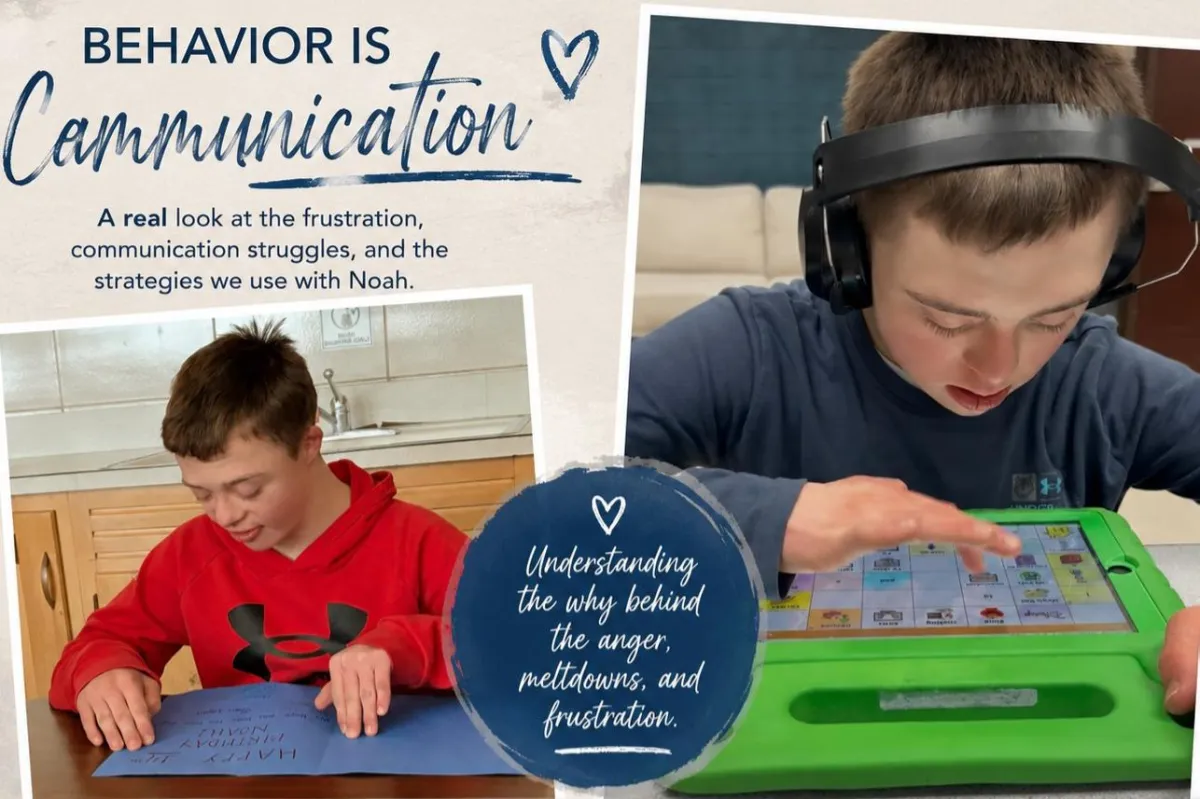
The school and Noah’s speech therapist also provided him with an Augmentative and Alternative Communication Device, also known as an AAC device. For Noah, this is basically an iPad with specialized software designed to help bridge communication gaps and reduce frustration.
Great, right?
Yes. In school it works wonderfully. He uses it all the time.
At home? Different story.
At home I plug it in, place it on the counter, and remind him to use it. In response, Noah either refuses or looks at me like I just asked him to solve advanced calculus. I know he understands how to use it. He just apparently prefers keeping us guessing for sport.
Asking Questions
Another tactic that works surprisingly well is simply asking questions when Noah is visibly upset.
Recently after school he was extremely irritable and acting out. I finally stopped and asked, “Noah, are you hungry?”
Immediately his behavior stopped. He paused, looked at me, and calmly said, “Yes.”
I told him, “You have to tell us when you are hungry. Ask for a snack.” Although honestly, helping himself to snacks has never really been an issue for Noah.
It was almost like he needed me to identify the feeling for him before he could connect the dots himself. He knew something felt wrong, but he could not figure out that the problem was hunger.
To be fair, I have also become irrationally angry over hunger before, so I cannot judge too much.
Writing Apologies and Repetition
Another strategy that has worked is repetition and writing apologies. Noah is not particularly fond of reading or writing, but he can do both.
As seen in the video, Shane had Noah write two sentences each afternoon for three days. Part of this was to reinforce what happened and part was to encourage him to apologize for hitting me. Hopefully after three days the message sticks.
When Shane asked Noah why he had to write the note, Noah responded, “I hit her.”
So he knew.
I honestly think his stomach hurt afterward because he felt bad about what happened. I will spare everyone the details, but let us just say guilt showed itself in dramatic fashion.
The difficult part is figuring out when something physically hurts versus when Noah is just answering “yes” to everything.
“Does your head hurt?”
“Yes.”
“Does your hand hurt?”
“Yes.”
“Does your foot hurt?”
“Yes.”
At that point I am standing there wondering if he is injured or just trying to win conversational bingo.
There have been a few rare occasions where Noah specifically said, “My head hurts” or “My ear hurts,” but generally that does not happen.
Time Out and Reflection
Another strategy is time out. Usually 5 to 10 minutes.
Before sending him there, we discuss what happened, what was wrong, how he responded, and what he could have done differently. Then we let him sit and think about it.
After the 5 to 10 minutes, we come back and ask him about the situation again.
Sometimes Noah responds appropriately. Other times he looks at us like we are completely insane or answers with something entirely unrelated.
At that point we repeat the process again.
Sometimes it takes one round. Other days it takes three or four rounds before Noah realizes he is not leaving time out until he can explain why he is there. Persistence becomes the family hobby.
When the Tantrum Has Already Started
If Noah is already in full tantrum mode, none of the above works. At that point the priority becomes safety.
We need to get him somewhere he cannot hurt himself or anyone else.
One time we were at a friend’s house for a sixteenth birthday party and Shane was able to take Noah outside. Noah was able to release his frustration safely in the yard where nobody got hurt and nothing got destroyed.
Another time we were at a friend’s house and there simply was not a safe place for him to calm down without risking injury, broken belongings, or both. Those situations are incredibly hard because you are trying to manage behavior while also mentally calculating the replacement cost of someone else’s furniture.
Eventually we took Noah into a bedroom away from the other friends and family. It was quieter, calmer, and there was less chaos and stimulation. Shane and I sat with him and worked through it with him until he made it through the worst part of the meltdown. Sometimes that is all you can do. Remove the noise, remove the audience, stay calm yourself, and help them ride out the storm without anyone ending up in the emergency room or needing to file an insurance claim.
The Safe Room Strategy
We also notice these outbursts happen more often when Noah is exhausted. Similar to a toddler fighting sleep like it is a competitive sport, Noah pushes himself until he simply cannot anymore.
In those moments we take him to his room. We intentionally keep it safe with soft items like pillows and blankets and remove anything he could destroy.
He is safe. We are safe. And he has the space to calm down.
Sometimes he falls asleep. Sometimes he just decompresses. Either way, everyone survives.
Just like there is no universal parenting handbook for rewards and consequences, there is definitely no one size fits all approach for Noah. There is no single answer for what works, what triggers behaviors, or how to help him communicate. Every situation is different. Every day is different.
What strategies have worked for your children? Especially if communication is difficult? I would love to hear what has helped your families.
Do not forget to follow us on Facebook and check out the video of Noah reading his apology letter if you have not already seen it. Join the chronicles of Life With Noah, where every day is part parenting adventure, part detective work, and part survival reality show.