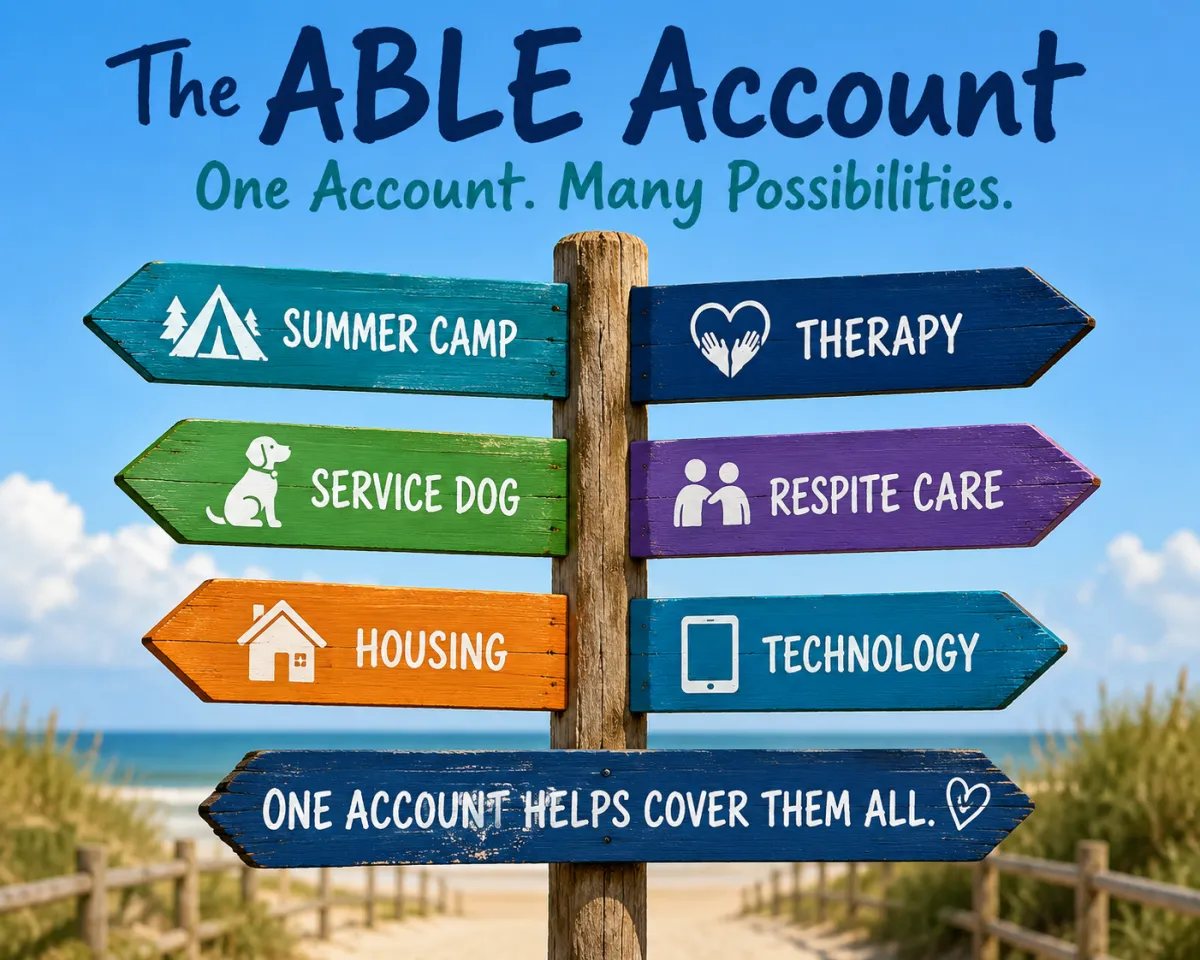
The ABLE Account: Explained by a Mom and CPAs Perpsective
The ABLE Account: One of the Best Things Nobody Told Me About
I recently used Noah's ABLE account to pay for respite care when it hit me...how many families do not even know this is an option?
Seriously. If you have a child or adult with a disability and you have never looked into an ABLE account, you could be missing out on one of the easiest financial benefits available.
So why would I move money into an ABLE account only to turn around and use it to pay for something? Why not just pay the bill from my checking account and call it a day?
Great question. I wondered the same thing years ago.
Before I go any further, one quick disclaimer. Besides being Noah's Mom, I am also a full time Professor of Practice in Accounting and a licensed CPA. What I am sharing is based on my experience as both a parent and an accountant. This is not tax advice. It is simply how I understand and use the ABLE account to benefit our family.
What is an ABLE Account?
According to the ABLE National Resource Center:
"An ABLE account is a savings and/or investment option for people with disabilities who qualify. The ABLE Act allows a person whose disability began before age 46 to save money in the ABLE account without affecting most federally funded benefits based on need. The money in the account may be used to pay for qualified disability expenses (QDEs). Any ABLE investment growth is not taxed and does not count as income if the funds are used for QDEs."
That is the official definition.
Here is the version I would tell a friend over coffee.
An ABLE account allows you to save or invest money for someone with a qualifying disability without affecting programs like Supplemental Security Income (SSI). The money grows tax free, and as long as it is used for qualified disability expenses, the earnings are not taxed.
In other words, it is one of those rare situations where the government actually gives families a break.
Does Every State Have an ABLE Program?
Almost.
According to the ABLE National Resource Center, every state except North Dakota, South Dakota, Idaho, and Wisconsin offers its own ABLE program. Even if you live in one of those states, you can still open an account through another state's program.
The Maryland Tax Benefit...and This Is the Good Part
If you live in Maryland, the tax benefits are worth paying attention to.
According to Maryland ABLE:
"Maryland contributors can claim a state income subtraction modification of up to $2,500 per year per beneficiary. Joint filers can deduct up to $5,000 per account. Excess contributions above $2,500 can be carried forward for up to 10 consecutive tax years."
Now let us translate that into English.
My husband and I can contribute up to $5,000 each year to Noah's ABLE account. That contribution lowers our Maryland taxable income, which means we pay less in Maryland state income tax.
Notice I said Maryland taxes. Your federal taxable income does not change, but many states offer similar benefits through their own ABLE programs.
It Is Not Just for Parents
Here is something many people overlook.
Grandparents, aunts, uncles, and other family members can contribute too.
I encouraged my parents to contribute to Noah's ABLE account instead of simply giving him birthday or Christmas money. If they were planning to give him money anyway, why not let everyone benefit from the tax advantages?
Think of it a little like a 529 college savings plan, except the money is intended for qualified disability expenses.
Here Is Where It Gets Really Useful
This is the part that made me a believer.
Suppose I know Noah will have several large expenses this year.
Maybe summer camp.
Maybe respite care.
Maybe therapy.
Maybe adaptive equipment.
Instead of paying those bills directly from my checking account, I can first contribute that money to Noah's ABLE account. I receive the Maryland tax benefit for making the contribution, then I withdraw the money from the ABLE account to pay the qualified expense.
Same money.
Same expense.
Less Maryland state income tax.
As an accountant, I appreciate that.
As a Mom, I appreciate it even more.
We Did This with Ozzy
Several years ago we began raising money for Noah's service dog, Ozzy.
We asked family members who wanted to help to contribute directly to Noah's ABLE account whenever possible. Shane and I also contributed as much as we could.
When it came time to pay for Ozzy and the related expenses, we withdrew the money from the ABLE account for those qualified expenses.
It was a simple strategy that allowed us to receive the Maryland tax benefit while still using those funds for Noah's needs.
And This Year...
Most recently, I used Noah's ABLE account to help pay for respite care.
We pay Noah's respite provider about $20 per hour. Whether I need to work, attend an appointment, or simply handle something Noah cannot participate in, those hours add up quickly.
Rather than paying directly from our checking account, I contributed money to Noah's ABLE account, received the Maryland tax benefit, and then used the funds to pay for his respite care.
The money still paid for the exact same service. The difference was that this approach saved us money on our Maryland taxes.
I will take that win every single time.
You Might Be Surprised What Qualifies
One of the biggest misconceptions is that ABLE accounts can only be used for medical bills.
Not even close.
What Can You Actually Pay For?
This was probably my biggest surprise when I first learned about ABLE accounts.
I assumed the money could only be used for doctor appointments, prescriptions, or medical equipment.
Not even close.
The IRS defines Qualified Disability Expenses (QDEs) very broadly. If the expense helps improve or maintain the health, independence, or quality of life of the person with a disability, there is a good chance it qualifies.
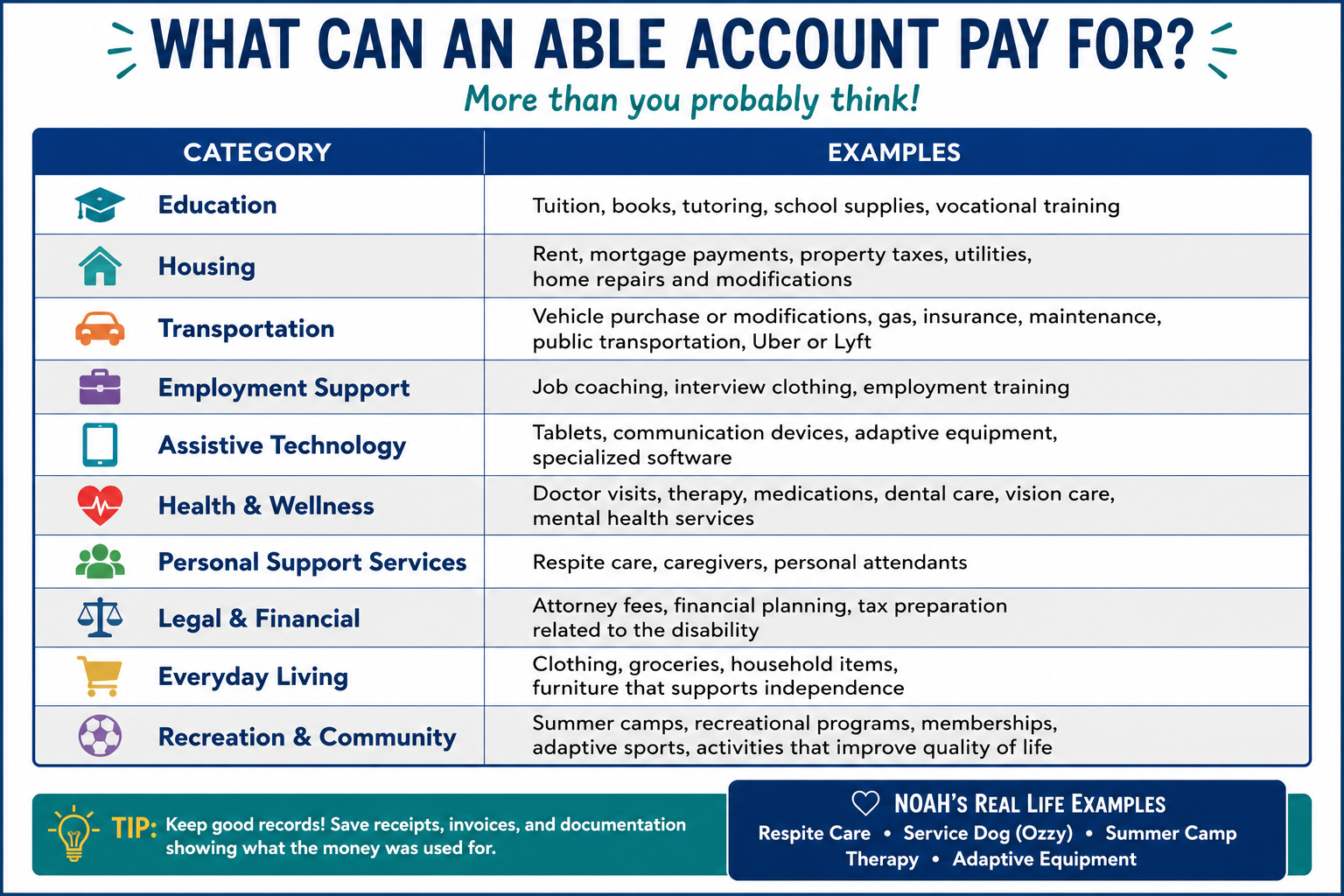
The list is much broader than most people realize.
Final Thoughts
If you have a loved one with a disability and you have never explored an ABLE account, I encourage you to spend a little time researching it. It has been one of the best financial tools we have found for Noah.
It is not flashy. It is not exciting. Nobody is making viral videos about ABLE accounts. Yet it has helped our family save money while making sure Noah has funds available for the things he needs.
Sometimes the best financial strategies are the ones nobody talks about.
If this post helped you understand ABLE accounts a little better, please share it with another family who may benefit. Follow us on Facebook, join our email list so you never miss a new post, and continue this journey with us. If sharing our experiences helps even one other family, then every story is worth telling.