When "Small for His Age" Became Something More
Noah and I have spent a good portion of our lives sitting in doctor’s offices. At this point I feel like I should earn hospital reward points or at least a free coffee punch card. If you are raising a child with Down Syndrome, chances are you understand exactly what I mean.
Children with Down Syndrome are at a higher risk for a variety of medical conditions including congenital heart defects, thyroid disorders, sleep apnea, hearing and vision concerns, and even early onset Alzheimer’s disease later in life. Because of these known risks, pediatricians and specialists usually monitor children with DS closely from infancy through adulthood. There are blood tests, sleep studies, cardiology appointments, scans, and enough paperwork to qualify parents for an honorary nursing degree.
For example, Noah has never shown signs of thyroid problems, but because individuals with DS are more likely to develop them, he is tested yearly. Most of us become accustomed to this type of routine monitoring. It becomes part of life.
What I did not realize was that there are some medical concerns that are not routinely discussed in the DS community, yet they can still have a major impact on our children’s health and development. One of those for Noah was Growth Hormone Deficiency, also known as GHD.
The Appointment That Changed Everything
Many of Noah’s specialists are through the University of Maryland. Thankfully, several travel to clinics closer to our area a few times each month because driving all over Maryland for appointments could honestly become a full time career.
During one of Noah’s cardiology appointments, I happened to run into a friend whose daughter was meeting with an endocrinologist. Her daughter does not have Down Syndrome, but she had stopped growing. Not “growing slowly.” Not “a little petite.” She had essentially stopped growing altogether and was eventually diagnosed with Growth Hormone Deficiency.
I truly believe that the Lord played a part in this conversation and it happened for a reason. Before that day, I had never even considered GHD as a possibility for Noah. Honestly, I did not even know it was something we should think about.
“Sweet and Petite” Was No Longer Cute
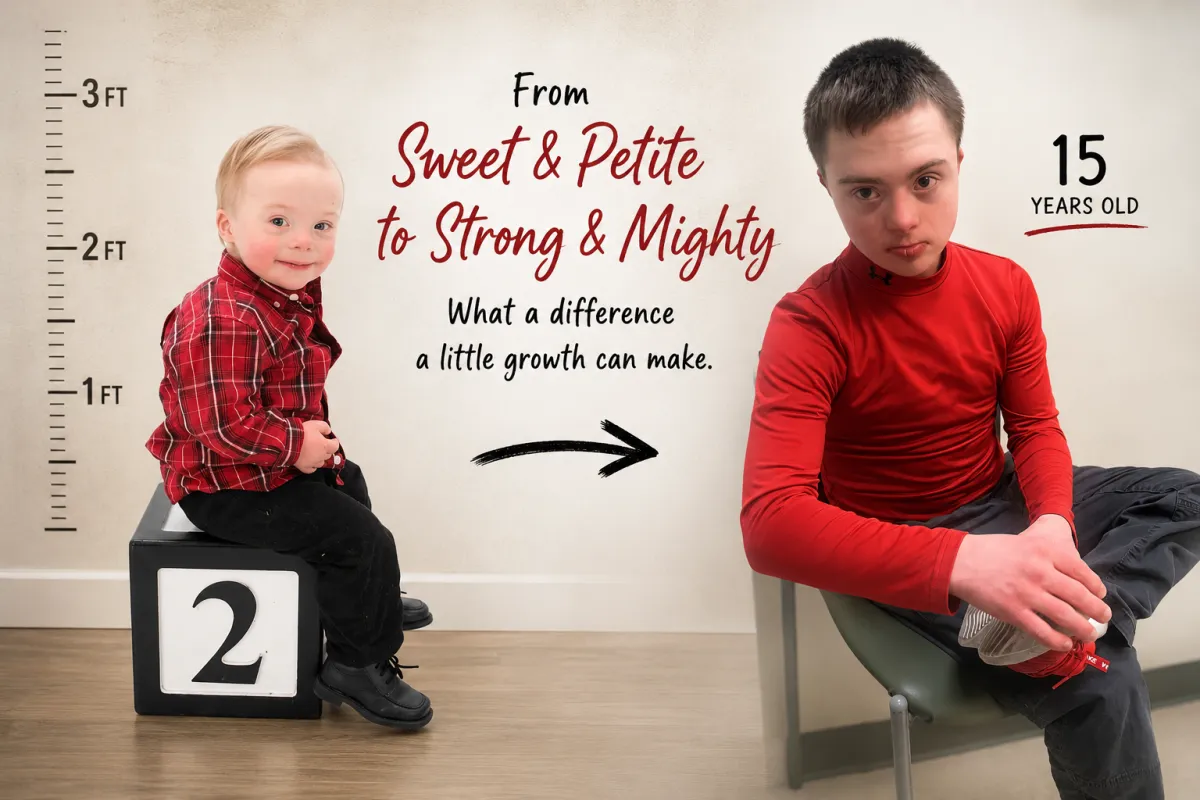
Noah has always been tiny. I used to jokingly call him “sweet and petite.” Children with Down Syndrome are often shorter in stature for several reasons including shorter long bones, hormonal differences, co occurring medical conditions, and other genetic factors. Smaller size did not immediately concern me because it seemed common in the DS community.
However, after speaking with my friend, I went home and started looking more carefully at Noah’s growth charts. That is when I realized something important: Noah was not simply short. Noah was not growing.
Children with Down Syndrome may grow differently than their peers, but they should still continue to grow. Noah had always been on the lower end of the Down Syndrome growth chart, but now he was no longer even charting on the DS growth curve for his age.
That definitely caught my attention.
I spoke with Noah’s pediatrician and his specialists at Kennedy Krieger Institute. Together we agreed it was worth having him evaluated by an endocrinologist.
More Tests. Because Of Course There Were More Tests.
This led us down another medical rabbit hole complete with blood work, a bone age scan of Noah’s hand, and a three hour hormone stimulation test. Because apparently medical testing believes parents have endless patience and children love sitting still for hours.
The results showed that Noah did, in fact, have Growth Hormone Deficiency.
Interestingly, the endocrinologist told us Noah was the first child with Down Syndrome she had personally treated for GHD. That alone made me realize how easily something like this could be overlooked. Many of us are so focused on developmental milestones, therapies, school concerns, heart issues, sleep, and behavior that growth hormone deficiency may never even cross our minds.
It Was Never Just About Height
The biggest concern was not necessarily Noah’s height. Growth hormone impacts much more than how tall a child becomes. Deficiencies can contribute to issues such as decreased bone density, low muscle tone, fatigue, metabolic concerns, and insulin resistance.
For families looking for reliable information, I highly recommend resources such as the National Down Syndrome Society (NDSS) and the Cleveland Clinic. Both provide helpful educational information regarding growth, hormone deficiencies, and related health concerns.
The Results Were Incredible
After more than a year of treatment, Noah grew over eight inches and gained approximately forty pounds. Suddenly our tiny little guy became much less tiny. He also became much stronger, which was both impressive and mildly terrifying considering Noah already treats furniture like gym equipment.
Eventually the doctors determined Noah was doing well and no longer needed treatment. Growth hormone therapy is often stopped after puberty depending on the child’s individual medical situation.
Like any treatment, there are potential side effects and risks, which is why research and conversations with trusted medical professionals are extremely important. There is never a one size fits all answer when it comes to medical decisions for our children.
Why I Am Sharing This
I am sharing this because I almost missed it completely. If I had not randomly, or not so randomly, run into a friend in a waiting room, I probably never would have asked questions about Noah’s growth.
Maybe Growth Hormone Deficiency is rare in children with Down Syndrome. Maybe it is under diagnosed. I honestly do not know. What I do know is that sometimes the medical issues we least expect are the ones worth paying attention to.
As parents, caregivers, and advocates, we spend so much time trying to keep up with everything our children need that it is easy for something to slip under the radar. My hope is simply that this story encourages another parent to ask questions, look at growth charts a little more closely, or start a conversation with their child’s doctor.
If you have faced similar experiences, questions, or concerns, please feel free to reach out. I always appreciate hearing from other families walking similar paths. Also be sure to follow our blog and join us on Facebook at Life with Noah where we share the chaos, humor, challenges, and victories that come with raising an amazing child with Down Syndrome.